The desert wind that once swept unimpeded across the Wadi Hanifa now navigates a skyline that defies gravity, tradition, and expectation. Riyadh, a city that grew from a mud-brick settlement into a G20 metropolis, is currently the world’s most ambitious architectural laboratory. For design lovers, the Saudi capital offers a physical timeline of a nation’s rapid metamorphosis. From the defensive clay ramparts of the 19th century to the parametric curves of the post-oil future, Riyadh’s built environment is a dialogue between its deep Najdi roots and its hyper-modern aspirations.
Here are the most iconic structures that define Riyadh’s architectural identity today.
The Origin
To understand where Riyadh is going, one must understand where it started. The Al Masmak Fortress is the city’s architectural “Patient Zero.” Built in 1865, this squat, thick-walled citadel made of clay and mud-brick is where the modern Saudi state began. Its design is purely functional, with small windows, tapering towers, and palm-trunk ceilings engineered to keep the heat out and enemies at bay. Just north lies the Al Murabba Palace, built in the 1930s by King Abdulaziz. While it retained the traditional Najdi style characterized by adobe walls and triangular ventilation, its sprawling scale signaled the city’s first expansion beyond its ancient fortifications. These early structures grounded Riyadh in pragmatism and place, but they were never designed to symbolize power—only to endure.
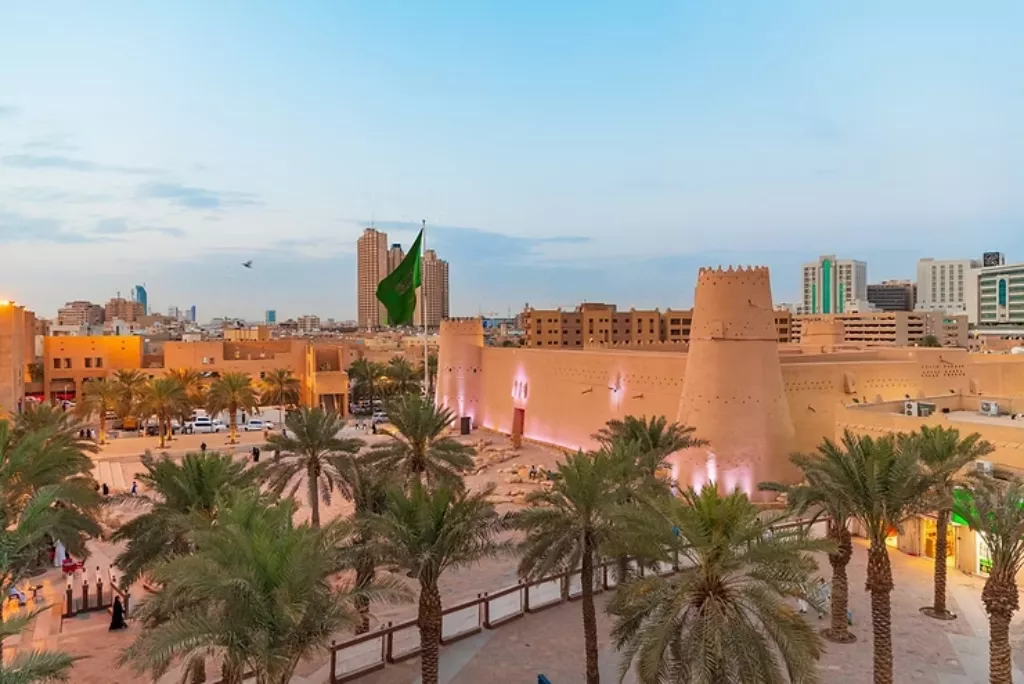
Al Masmak Fortress in Riyadh | Almosafer
The Vertical Pioneers
With oil wealth, globalization, and a desire for international recognition, endurance was no longer enough—Riyadh needed symbols. As the millennium turned, the city looked up. The city’s skyline is anchored by two giants that have become shorthand for the capital itself.
Al Faisaliah Tower, completed in 2000 and designed by Foster + Partners, introduced a distinctly global architectural language to Riyadh at the turn of the millennium. Its sharply tapering triangular form culminates in a suspended glass sphere, a feat of engineering that houses a restaurant with 360-degree views. Structurally, the tower relies on a perimeter diagrid system that allows for column-free interiors, while its slender geometry minimizes solar exposure.
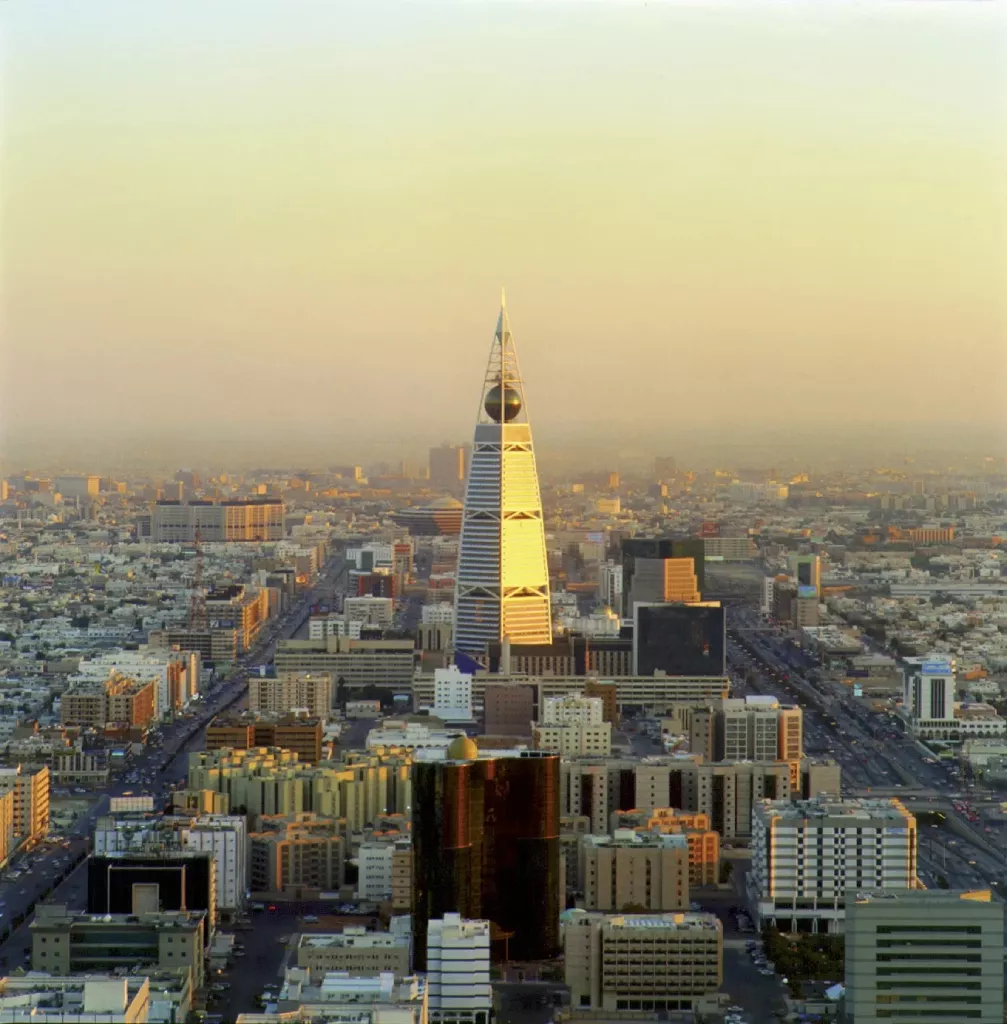
Al Faisaliah Tower | AD
Across the city stands its partner in the skyline, the Kingdom Centre, designed by Omrania & Associates with Ellerbe Becket. Rising 302 metres above the city, the Kingdom Centre is less a tower and more an urban marker. Its defining void, the monumental inverted arch at the crown is not ornamental but performative, reducing wind load while framing a skybridge that offers panoramic views of the desert metropolis. The tower’s tripartite programme stacks retail, hospitality, office space, and a sky-level mosque, choreographing vertical urbanism long before it became a global trope.
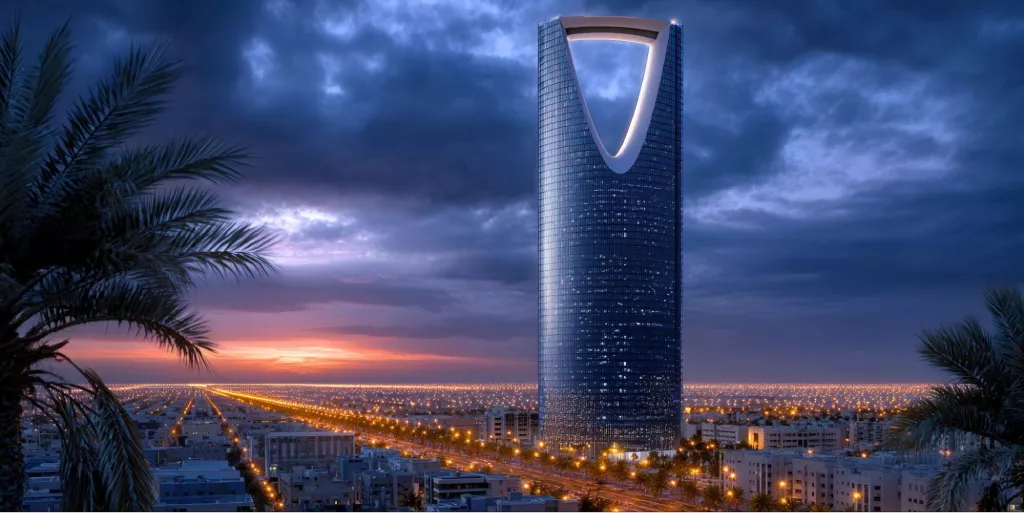
Kingdom Center | Vecteezy
The Geometric Spiritualist: KAFD Grand Mosque
Deep within the steel forest of the King Abdullah Financial District (KAFD) sits a structure that challenges the typology of religious architecture: the KAFD Grand Mosque.
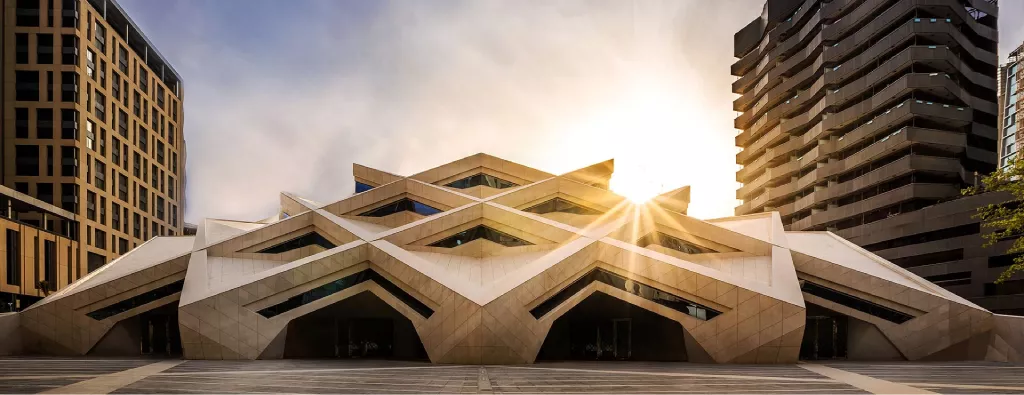
Kingdom Center | Omrania
The building is conceived as a low, introverted volume, organised around a modular structural grid that creates a flexible, column-free prayer hall. Natural light is carefully filtered through skylights and perforated surfaces, allowing illumination to define spatial hierarchy without reliance on ornament. Materially subdued and deliberately horizontal, the mosque establishes a moment of stillness within the vertical, corporate urbanism of KAFD. Its architectural significance lies in how it integrates spiritual space into a financial district, positioning religious architecture as an integral component of Riyadh’s modern civic framework rather than a symbolic add-on.
The Parametric KAFD Metro Station
If the Grand Mosque represents stillness, the KAFD Metro Station represents velocity. Designed by Zaha Hadid Architects, the station is a testament to the late architect’s genius for fluidity. It serves as the interchange for three metro lines, guiding passenger movement intuitively through light, curvature, and spatial compression. The design concept mimics the “sine waves” of desert dunes, with a facade of ultra-high-performance concrete perforated to filter the harsh sun, a high-tech homage to the mashrabiya screens of old. It is a building that functions as a public plaza, a transit hub, and a piece of frozen motion.
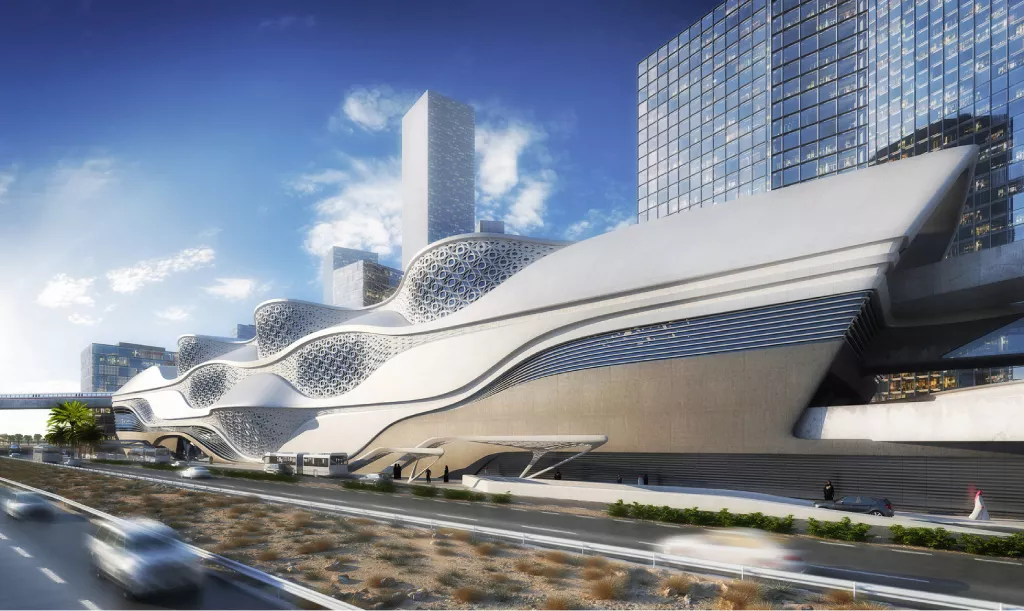
KAFD Metro Station | Archdaily
The New Arenas: Culture and Sport
As Riyadh pivots to becoming a global capital of entertainment, the architecture is shifting from corporate towers to cultural arenas.
In the Diplomatic Quarter, the Attache project by Bricklab offers a stunning example of adaptive reuse. What was once a 1990s equestrian facility has been transformed into a headquarters for MDL Beast (a global music and new media platform). Rather than demolishing the faux-Najdi structures, Bricklab treated them as a canvas, inserting a bold, industrial palette of “RGB” colors that contrast sharply with the desert earth tones. The building is organised as a series of stacked and interlocking volumes, articulated through deep recesses, shaded loggias, and controlled openings that respond to Riyadh’s harsh climate.
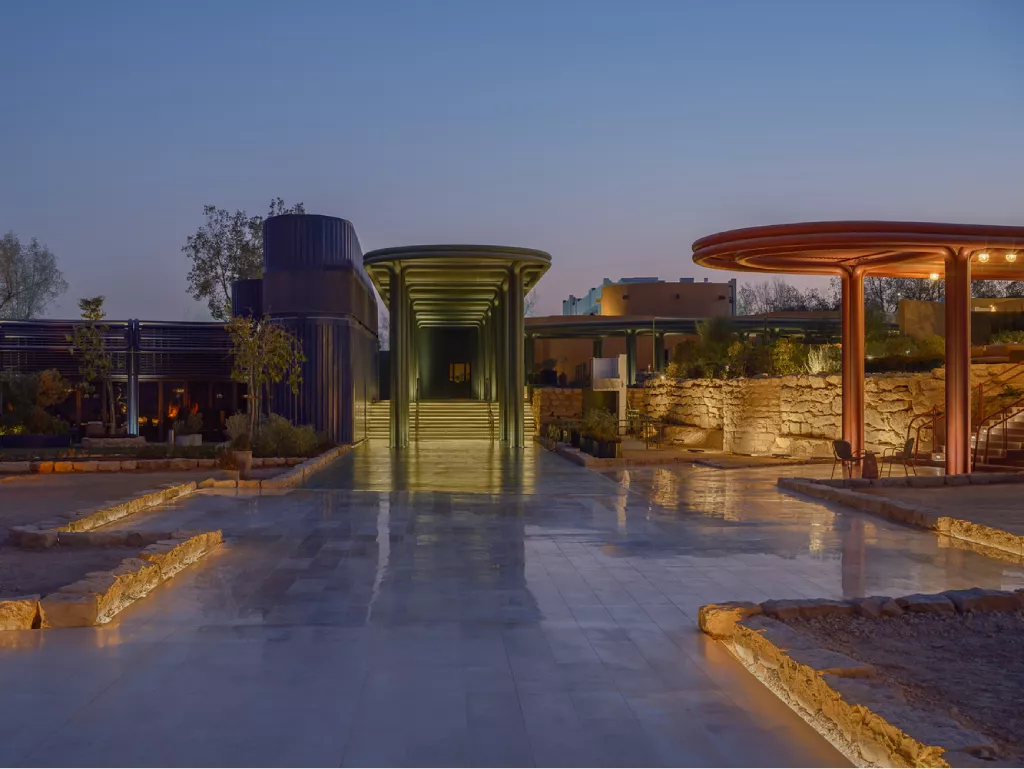
Attache by Bricklab | Archdaily
Meanwhile, sports architecture is reaching a fever pitch. The King Salman Stadium, designed by Populous, is set to be the centerpiece of the 2034 FIFA World Cup. Its roof structure draws inspiration from desert landforms, while the stadium bowl is embedded within a larger landscape system of public parks, walkways, and community facilities. Parametric roof geometries optimize shading and airflow, addressing thermal comfort at an unprecedented scale.
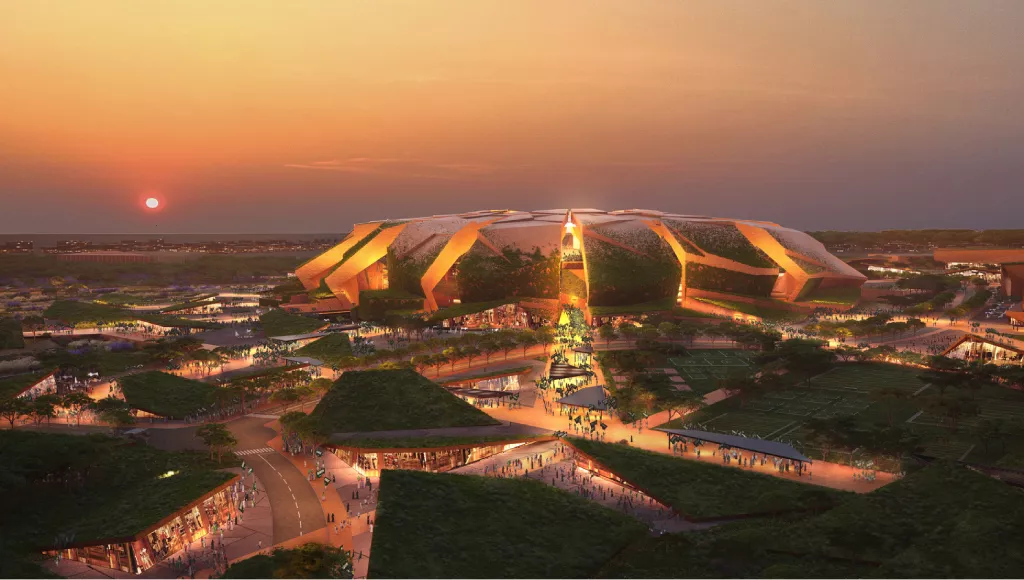
King Salman Stadium | Archdaily
Similarly, the House of Nassr by Portuguese firm OODA redefines sports architecture in Saudi Arabia by rejecting the closed, introverted typology of conventional training facilities. Instead, it employs layered façades, shaded courtyards, and porous circulation to create visual and spatial continuity between athletes and the city. While the overall project is in progress, the first phase was completed in 2025, marking OODA’s first realized project in Saudi Arabia.
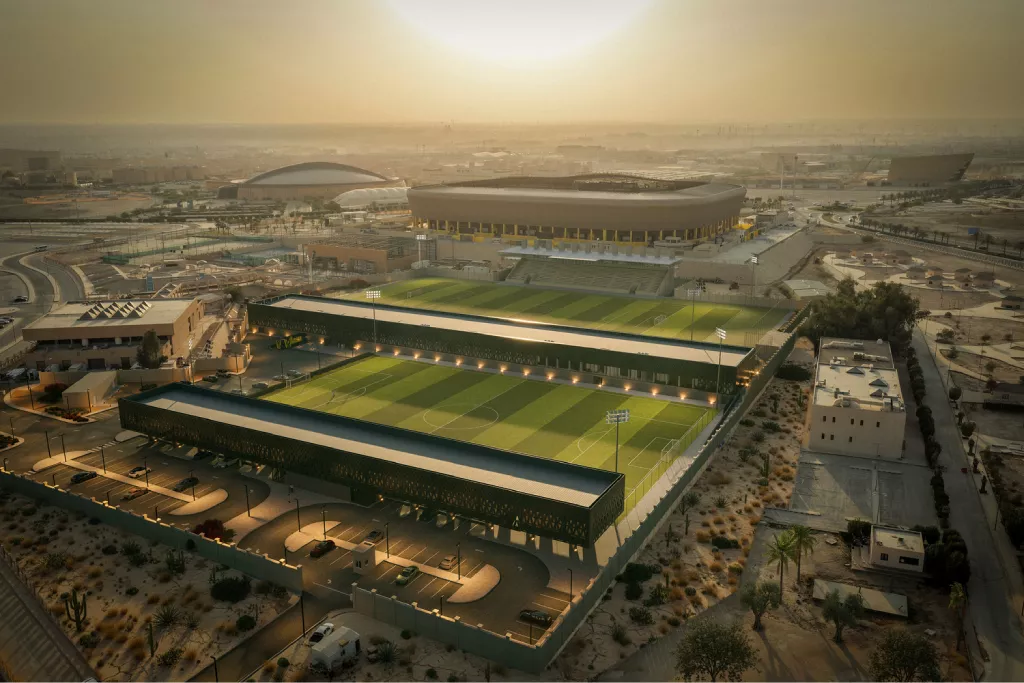
House of Nassr | Archdaily
Riyadh is no longer just importing “starchitects” to drop glass boxes into the sand. The emerging architectural narrative evident in the geometric precision of the KAFD Mosque and the adaptive reuse of the Attache suggests the future doesn’t have to erase the past. In Riyadh, the mud-brick and the parametric coexist, building a skyline that is as complex as the history it rests upon.
References
- https://www.admiddleeast.com/story/the-most-iconic-buildings-in-riyadh-landmarks-every-design-lover-should-know
- https://seattlestravels.com/must-see-landmarks-in-riyadh/
- https://www.harpersbazaararabia.com/culture/what-to-see-in-saudi-architect-rabaa-al-othaim-takes-us-on-a-tour-of-her-favourite-spots-in-the-capital
- https://www.visitsaudi.com/en/riyadh/stories/capital-of-culture-
- https://www.csbe.org/riyadh-architecture-in-one-hundred-years-1
- https://parametric-architecture.com/case-study-kafd-grand-mosque-riyadh/
- https://www.archdaily.com/1023727/populous-unveils-the-king-salman-stadium-in-riyadh-the-largest-venue-to-host-fifa-2034-world-cup?ad_campaign=normal-tag
- https://www.archdaily.com/1036372/attache-bricklab
- https://www.archdaily.com/1037353/ooda-unveils-house-of-nassr-sports-complex-its-first-realized-project-in-saudi-arabia
- https://www.passportsandpreemies.com/things-to-do-in-riyadh/
- https://omrania.com/project/kafd-grand-mosque/
- https://www.archdaily.com/374198/zaha-hadid-architects-selected-to-design-the-king-abdullah-financial-district-metro-station-in-saudi-arabia-2