In the quiet, leafy stretches of Holland Park Road, the grey London sky often presses down on rows of respectable, unassuming brickwork. Yet, behind one such sober façade lies a secret that has whispered exactly a century. As you stand before the heavy door of Number 12, you are not merely entering a Victorian artist’s studio; you are stepping into a suspended dream of the East, a “private palace of art” that, in this centenary year of 2026, remains as provocative and breathtaking as the day it was finished.
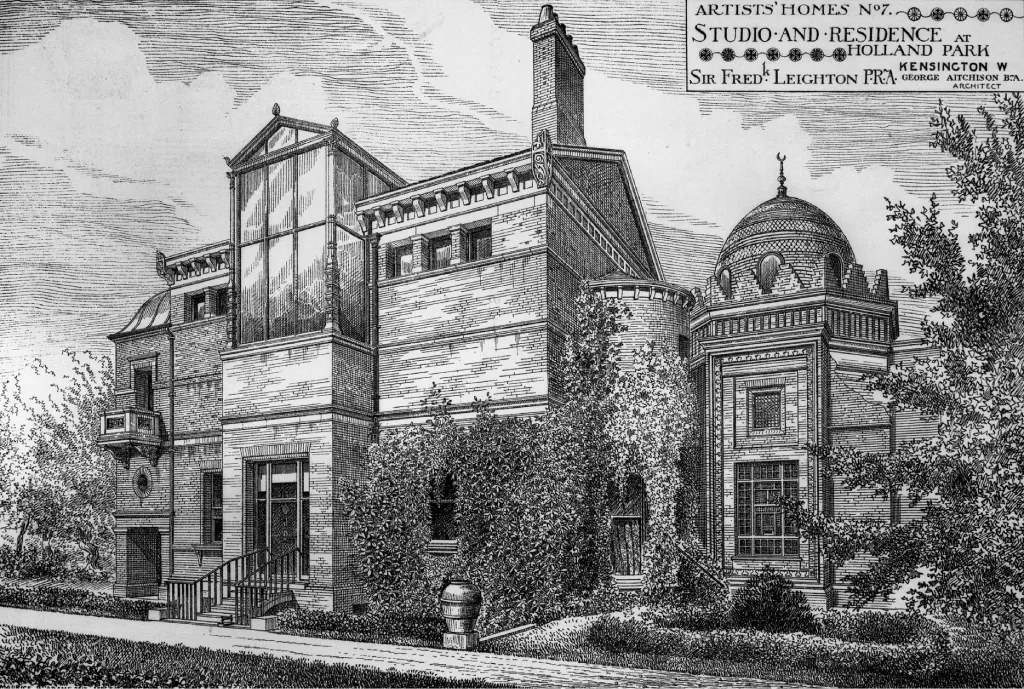
Architectural sketch of the northern elevation originally done by James Akerman | Orientations
Welcome to Leighton House, the former home of the celebrated Victorian artist Frederic, Lord Leighton. While the museum celebrates its 100th birthday as a public institution this year with a blockbuster series of exhibitions, the true guest of honor remains the house itself, specifically, its architectural crown jewel: the Arab Hall.
The Threshold of Wonder
To experience the Arab Hall is to understand the power of contrast. The journey begins in the entrance hall, a space of dark, ebonized wood and relatively subdued tones. It is a deliberate palate cleanser, designed by architect George Aitchison to reset the senses. But as you move forward, the architecture begins to pull you in.
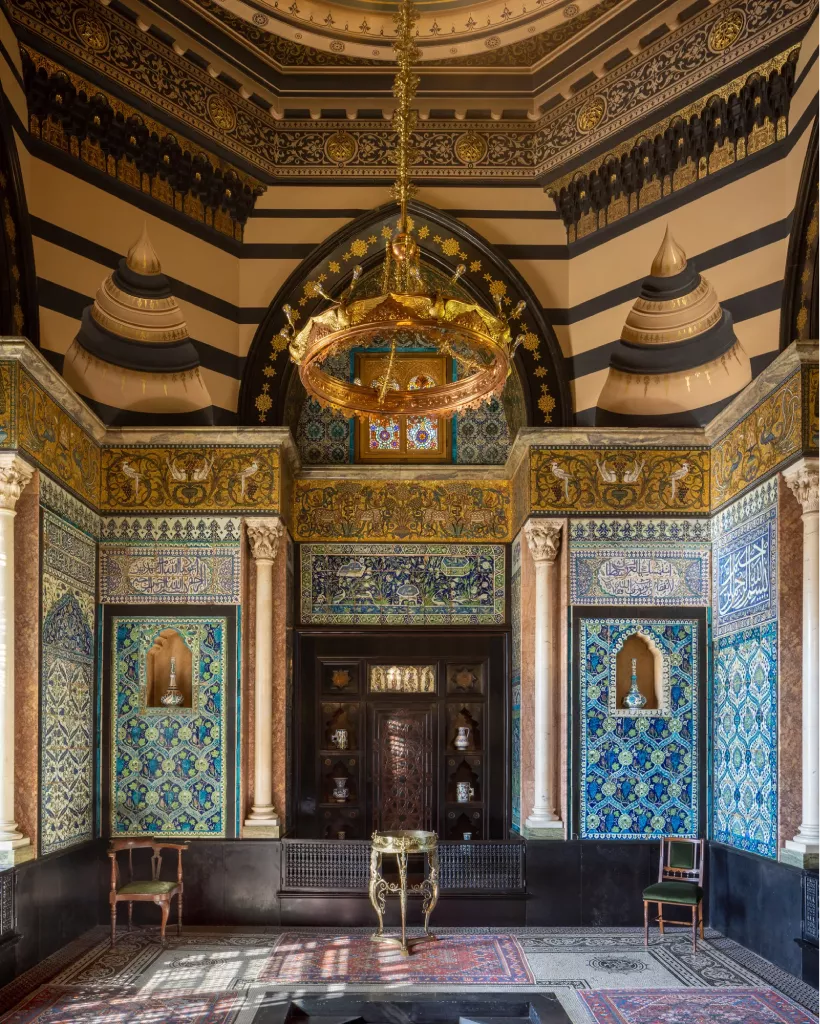
Arab Hall | AD
You pass through the Narcissus Hall, where the walls suddenly ignite with a deep, piercing turquoise. These are tiles by the ceramicist William De Morgan, their cool aquatic hues preparing you for the warmth beyond. The light changes; the acoustics shift. You are no longer in West London.The room acts as a link between the main part of the house and the Arab Hall.
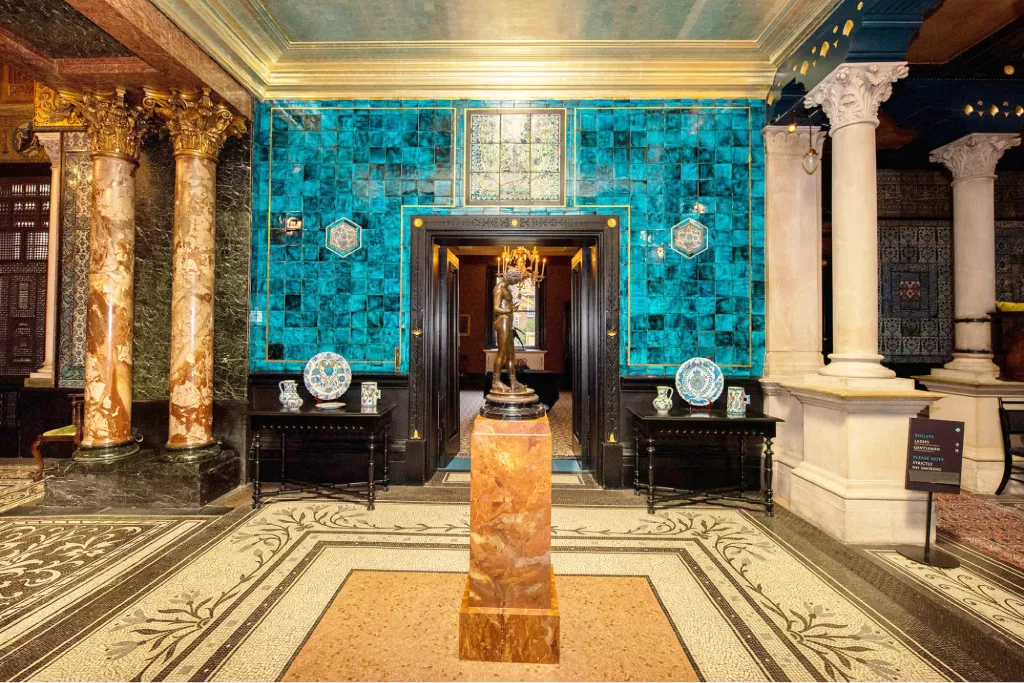
Narcissus Hall, named for its centrepiece, a bronze of the eponymous figure from Greek mythology | Christies
Into the Golden Heart
Stepping into the Arab Hall is a physical sensation. The first thing that hits you is the sound: the gentle, rhythmic trickle of a fountain. In the center of the room, a single jet of water rises from a black marble basin, slicing through the silence. Leighton originally installed a white marble basin but replaced it with black to better reflect the shimmering golden dome above, a masterstroke of atmospheric design.
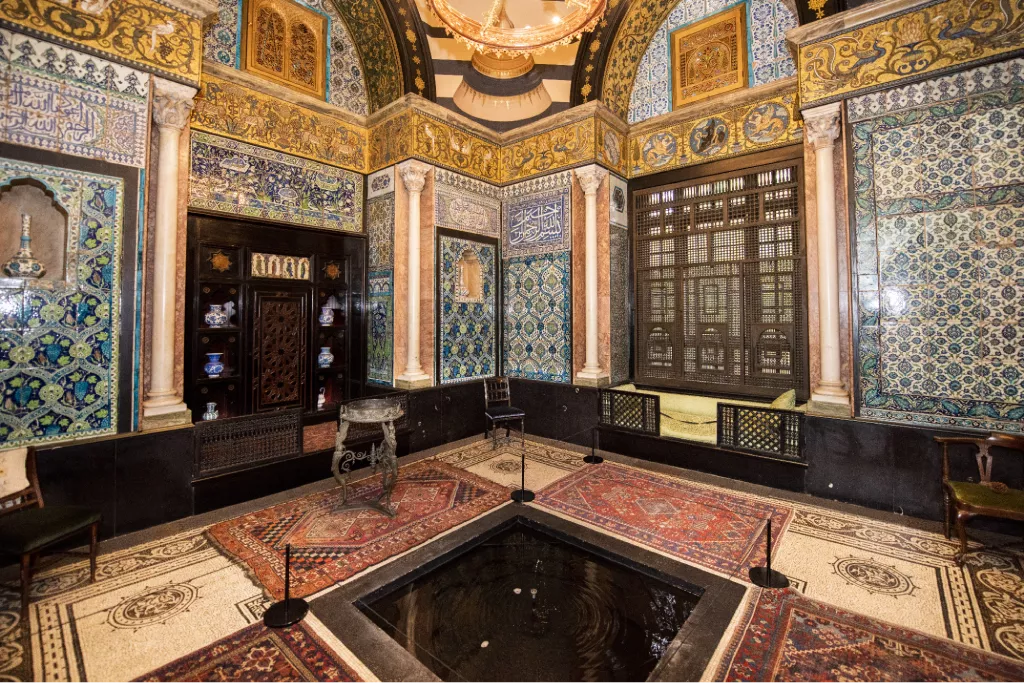
The Arab Hall with the fountain in the middle | RBKC
Look up. The dome is the room’s celestial navigation, a high, vaulted cupola gilded in mosaic that catches the dim light and scatters it like stardust. It creates a soft, amber glow that seems to emanate from the architecture itself rather than any external source.
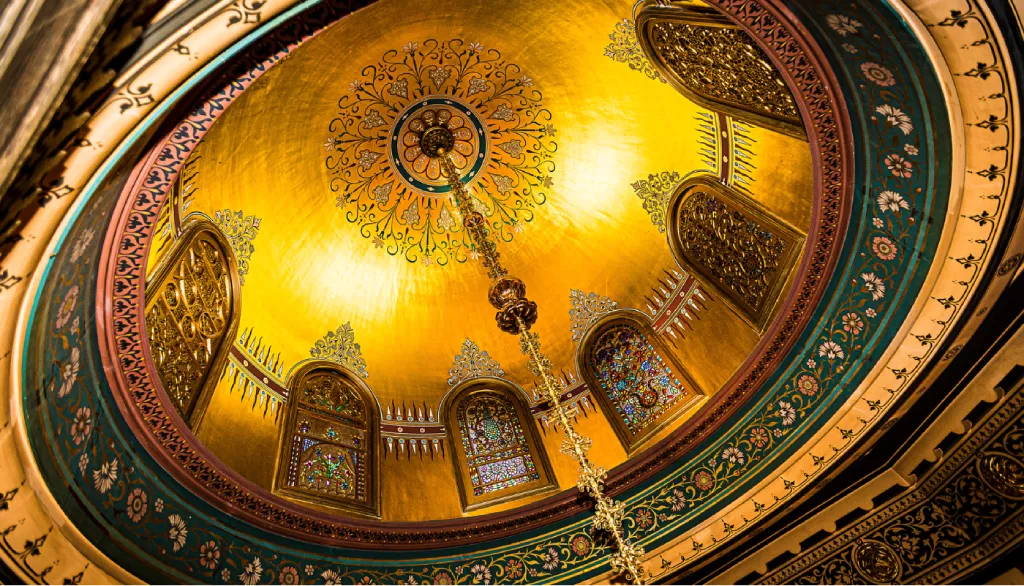
Interior of the dome of the Arab Hall with coloured-glass windows | RBKC
The walls wrapping around you are a museum in their own right, lined with hundreds of authentic Iznik and Damascene tiles dating back to the 16th and 17th centuries. Leighton didn’t just commission a copy of the East; he collected it. During his travels to Turkey, Egypt, and Syria in the 1860s and 70s, he amassed these ceramic treasures, their surfaces painted with tulips, carnations, and cypress trees in vivid blues, emerald greens, and tomato reds. Where gaps existed in the ancient panels, the meticulous hand of William De Morgan filled them in, his reproductions so seamless they blur the line between the Ottoman Empire and Victorian Kensington.
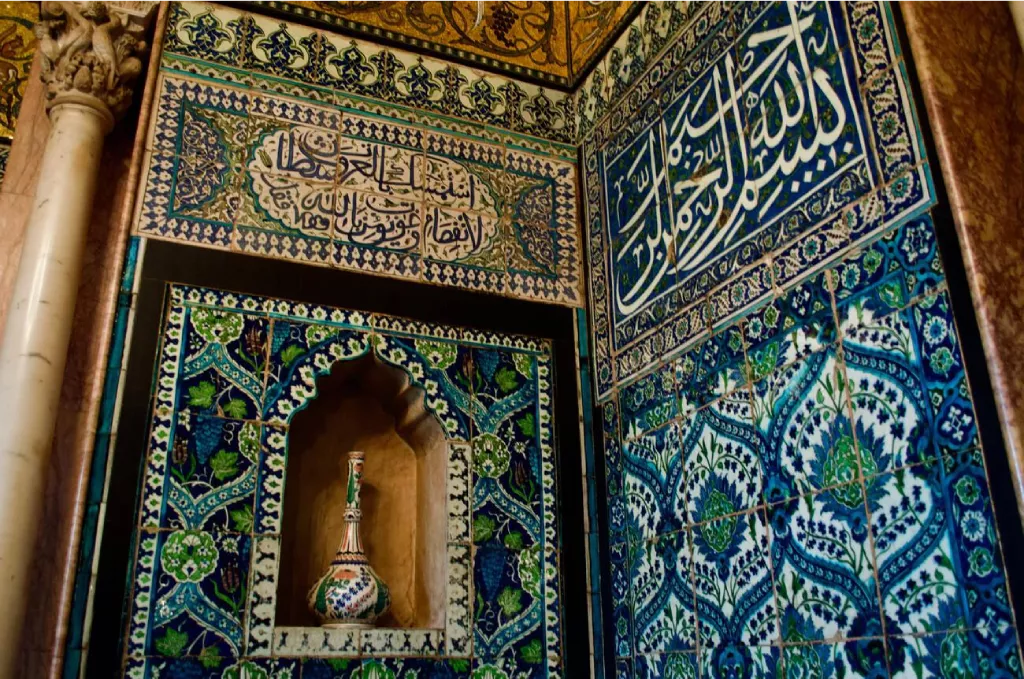
Authentic Iznik and Damascene tiles on the northwest corner of the Arab Hall | Alarmy
A Symphony of Light and Shadow
The architectural genius of the Arab Hall lies in its handling of light. Mashrabiya screens, intricate wooden lattices brought from the Middle East cover the windows. They filter the grey London daylight, breaking it into soft, geometric patterns that dance across the mosaic floors.
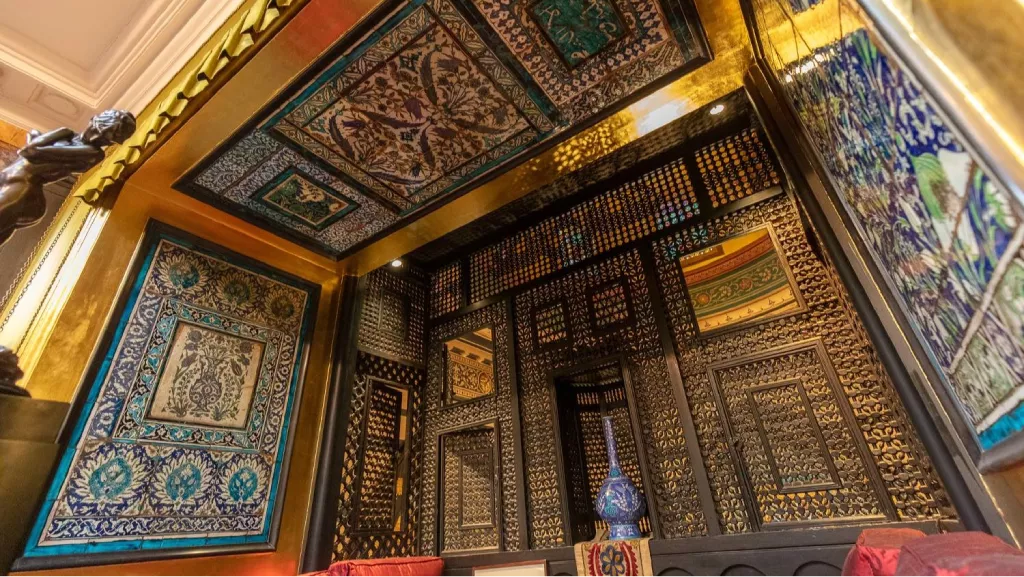
Intricate wooden mashrabiya latticework in Arab Hall | Middle East Eye
To your left and right, recessed alcoves offer divans piled with silk cushions. It is easy to imagine the Victorian elite here, reclining in smoking jackets, the air thick with conversation and tobacco smoke, completely insulated from the industrial reality of 19th-century London outside. The space was built, in Leighton’s own words, “for the sake of something beautiful to look at once in a while.” It is a machine for aesthetic contemplation.
The Centenary Celebration
To mark the centenary of its opening to the public in 1926, the house is hosting a series of exhibitions & events running from February to October that contextualizes this masterpiece.
- Centenary After-Hours (Feb 19, 2026): An evening event featuring the new exhibitions with live music and a bar.
- Leighton House: A Journey Through 100 Years (Through March 1, 2026): Located in the Tavolozza Drawings Gallery, this exhibition chronicles the building’s transformation from a private studio-home to a museum.
- Ghost Objects: Summoning Leighton’s Lost Collection (Through March 1, 2026): Artist Annemarieke Kloosterhof recreates four missing items from Lord Leighton’s original collection as white paper sculptures
- The Arab Hall Project (Opening March 21, 2026): Features three contemporary artists creating site-specific, Middle Eastern and North African-inspired works to complement the historic space.
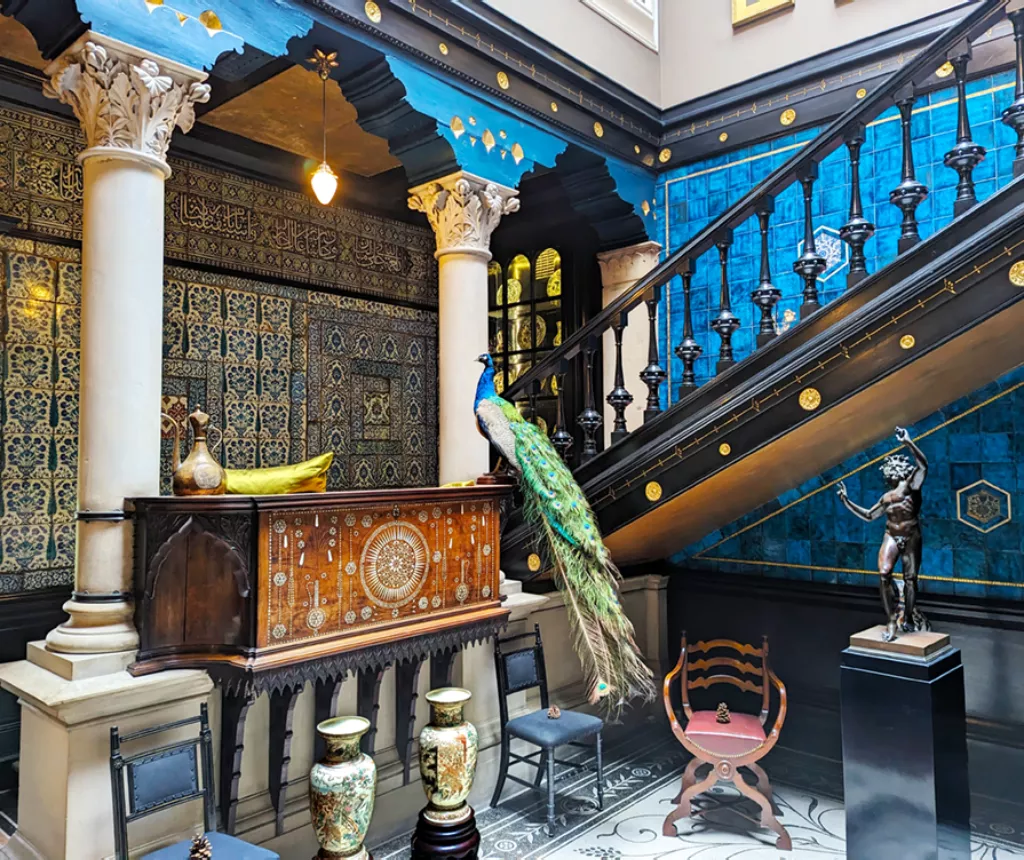
Entrance foyer of Leighton House Museum | Postcard
As you turn to leave, retracing your steps through the Narcissus Hall and back out into the British chill, the sensation is one of waking from a vivid, lucid dream. Leighton House does not just display art; it immerses you in it. The Arab Hall stands not as a pastiche, but as a sincere love letter to the Islamic world, written in tile, gold, and water. In 2026, a hundred years after it opened its doors to us all, it remains London’s most beautiful surprise.
References
- https://postcardsfromsanantonio.com/2025/02/17/postcard-from-london-england-painters-former-home-exotic-as-a-peacock/
- https://www.admiddleeast.com/story/inside-leighton-house-londons-hidden-arabic-escape-turns-100
- https://www.rbkc.gov.uk/museums/arab-hall-leighton-house
- https://www.rbkc.gov.uk/museums/history-leighton-house
- https://www.orientations.com.hk/highlights/an-oriental-kiosk-the-building-of-the-arab-hall-at-leighton-house-in-london
- https://www.timeout.com/london/news/ this-underrated-tiny-west-london-museum-is-celebrating-its- 100th-birthday-with-a-blockbuster-year-of-exhibitions-in- 2026-020526
- https://www.middleeasteye.net/discover/leighton-house-london-middle-east-escape
- https://www.houseandgarden.co.uk/article/leighton-house
- https://artistsathome.emorydomains.org/exhibits/show/oriental-design-arab-hall/the-arab-hall
- https://www.youtube.com/watch?v=0bnb1SZGg_U