Every generation builds monuments to the stories it wants to preserve. On Saadiyat Island, Abu Dhabi is doing just that through its Cultural District, a carefully planned constellation of museums and civic spaces. It has rapidly cemented itself as an urban ecosystem, a place where high-end hospitality, civic ambition, and haute architecture converge in a meticulously designed walkable district. Now, joining the luminous ranks of Jean Nouvel’s Louvre and the forthcoming Guggenheim, the newly inaugurated Natural History Museum Abu Dhabi emerges as a monumental love letter.
Opened in late 2025, this sprawling 35,000-square-meter tour de force by the acclaimed Dutch architectural practice Mecanoo is far more than a repository for ancient relics. It is a profound exercise in spatial choreography and urban integration, an institution that reimagines the curation of deep time through an unmistakably modern, distinctly Arabian lens.
Beyond its architectural spectacle, the museum is also designed as a dynamic educational hub, with immersive digital displays, research facilities, and interactive galleries that invite visitors to engage directly with the evolving story of Earth’s history.
The Urban Wadi: A Masterclass in Contextual Form
To approach the museum is to encounter a building that refuses to behave like a traditional, hermetically sealed institution. Lead architect Nuno Fontarra drew initial aesthetic inspiration from the rugged, wave-battered tidal rocks of his memories in Porto, Portugal, but the resulting structure is an exquisite, highly contextualized translation of the Arabian wadi.
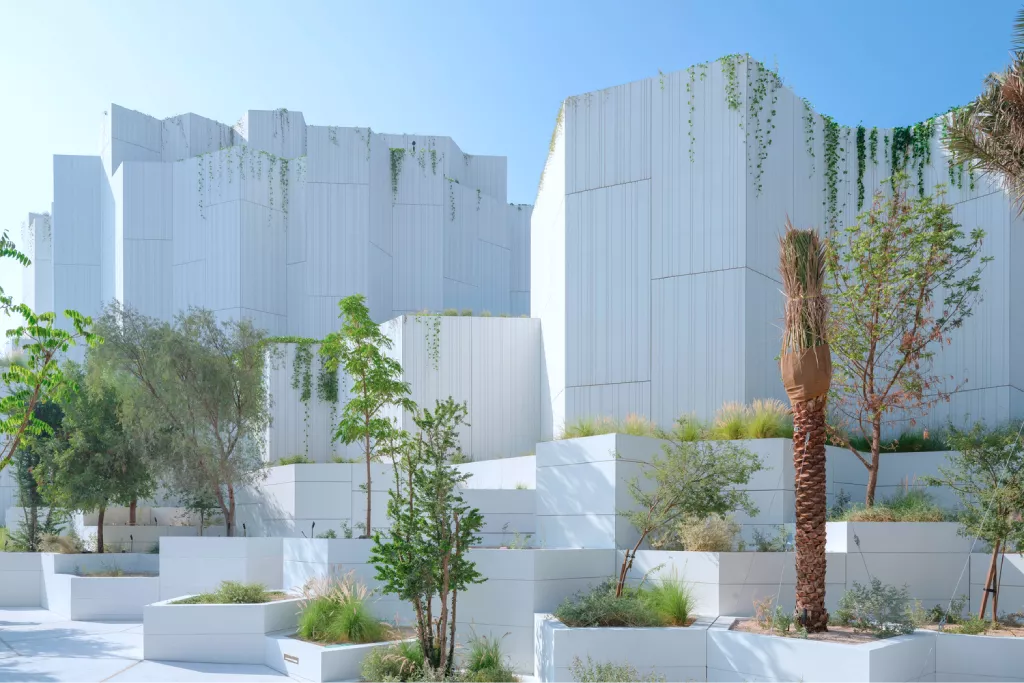
Approach of the Museum | ArchDaily
The museum rises from the island’s waterfront like a primordial, undulating rock formation, its sprawling, monolithic volumes acting as an organic bridge between land and sea. It is a masterclass in urban design, circulation routes are entirely fluid and porous, dissolving the rigid boundaries between the building’s monumental stone facades, the lush, ground-level botanical gardens, and the azure expanse of the Arabian Gulf.
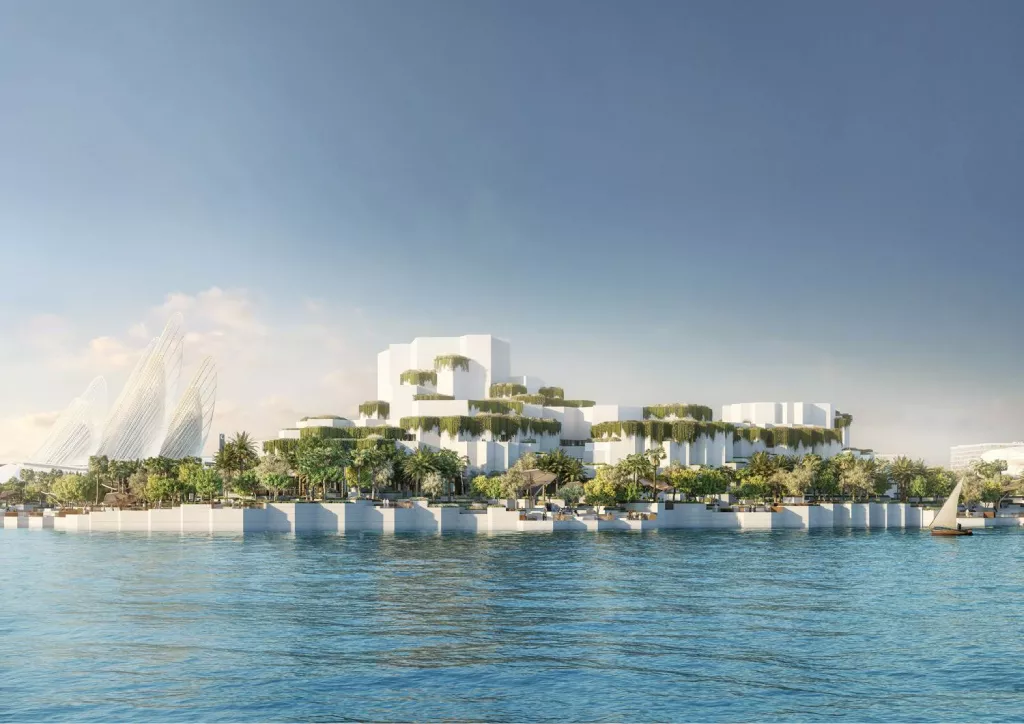
Museum Emerging from the Water | Mecanoo
Cellular Interiors
Crossing the threshold, the interior architecture immediately trades the austere, white-box conventions of traditional gallery spaces for a deeply grounding, geometric warmth. Mecanoo employed the pentagon as a unifying structural and aesthetic motif throughout the floor plan, echoing the fundamental cellular building blocks of life itself. This modularity informs the entire spatial flow, allowing the architecture to behave like a living organism.
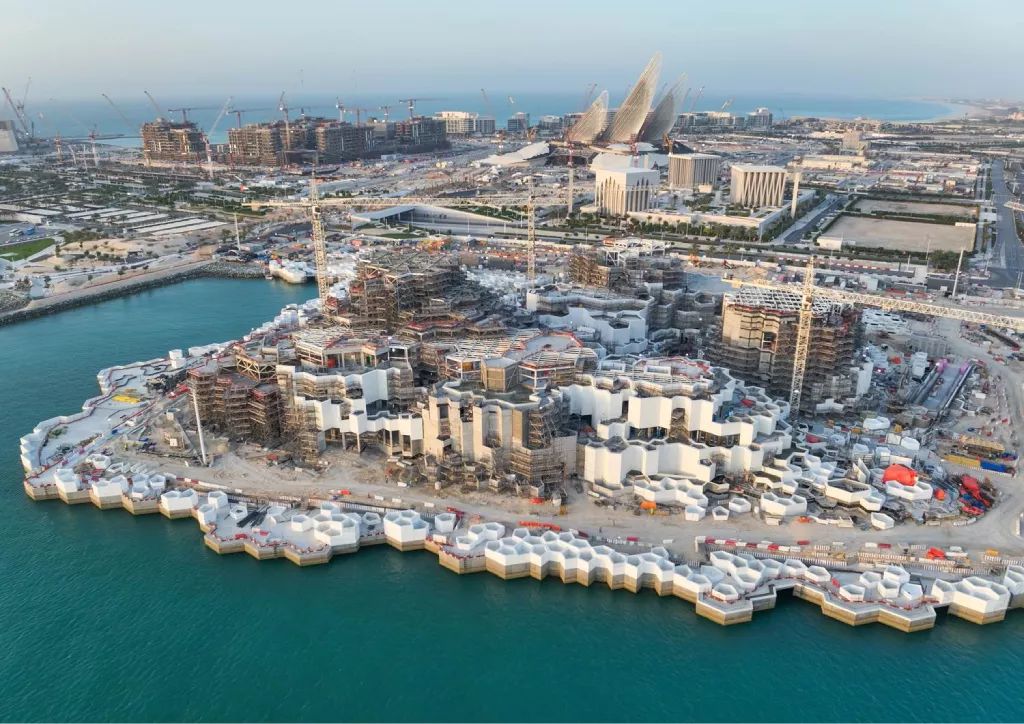
Pentagon Used as a Building Block | Mecanoo
It creates intimate, compressed enclaves of discovery that suddenly open into breathtaking, light-filled volumes. Hanging gardens cascade gracefully through the interior voids, while sleek, minimalist water features mirror the geometry of the rooflines—potent, luxurious symbols of life and resilience thriving in a desert context. Crucially, the state-of-the-art climate and air-quality systems, which are absolutely essential for the preservation of delicate, multi-million-year-old fossils, are invisibly woven into the refined finishes. There are no exposed ducts or visual clutter; the spatial purity remains entirely undisturbed, leaving only the sensory experience of the architecture.
Hanging Gardens Maintains Micro-Climate | ArchDaily
Choreographing Scale: A New Paradigm in Exhibition Design
The sheer theatricality of the museum’s interior design is perhaps most spectacular in the soaring main atrium. Here, the architectural scale is tested and met by the prehistoric. Upon entering, visitors are greeted by an awe-inspiring herd of five towering, 75-foot sauropods, including a Diplodocus and a Brachiosaurus.
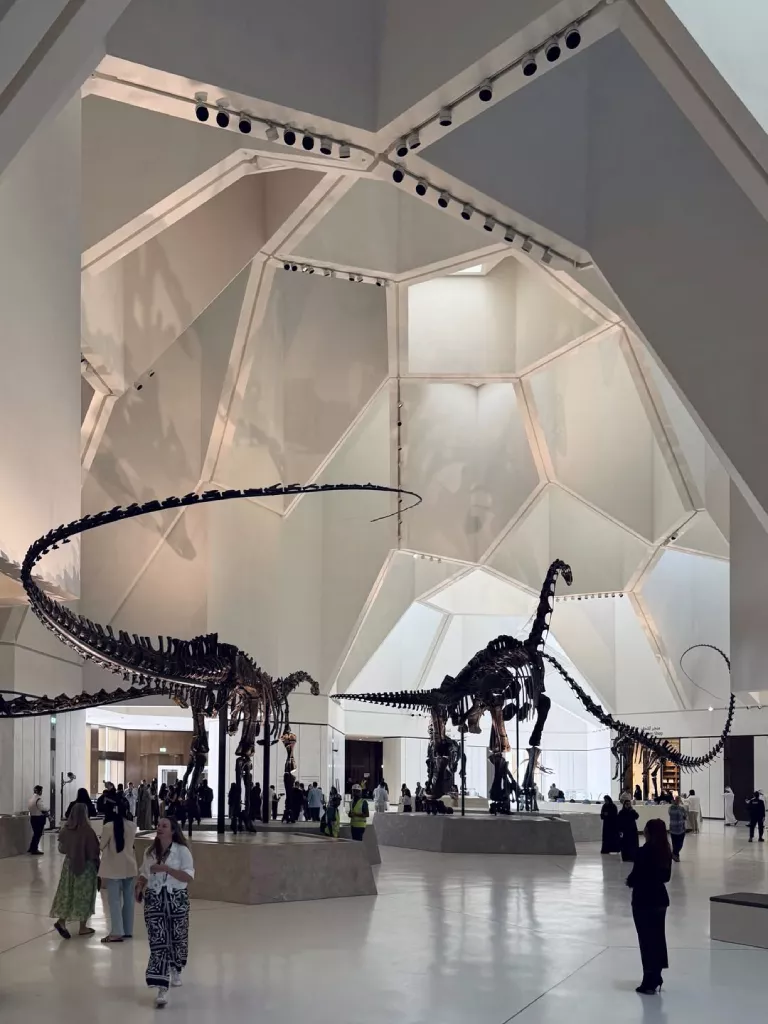
Instagram
Yet, in a bold and brilliant departure from traditional exhibition design, there are no velvet ropes, no raised plinths, and no glass barriers separating the observer from the display. The spatial arrangement invites guests to walk directly amidst the toes of these gentle giants. This curatorial decision establishes a visceral, unfiltered connection between the human form and the colossal.
Theatrical Paleontology: Mounting the Apex Predator
As one navigates deeper into the cellular galleries, the curation continues to leverage interior space for maximum dramatic and emotional impact. The undeniable crown jewel of the collection is “Stan,” the 67-million-year-old, 38-foot Tyrannosaurus rex, widely considered one of the most pristine and complete specimens ever unearthed.
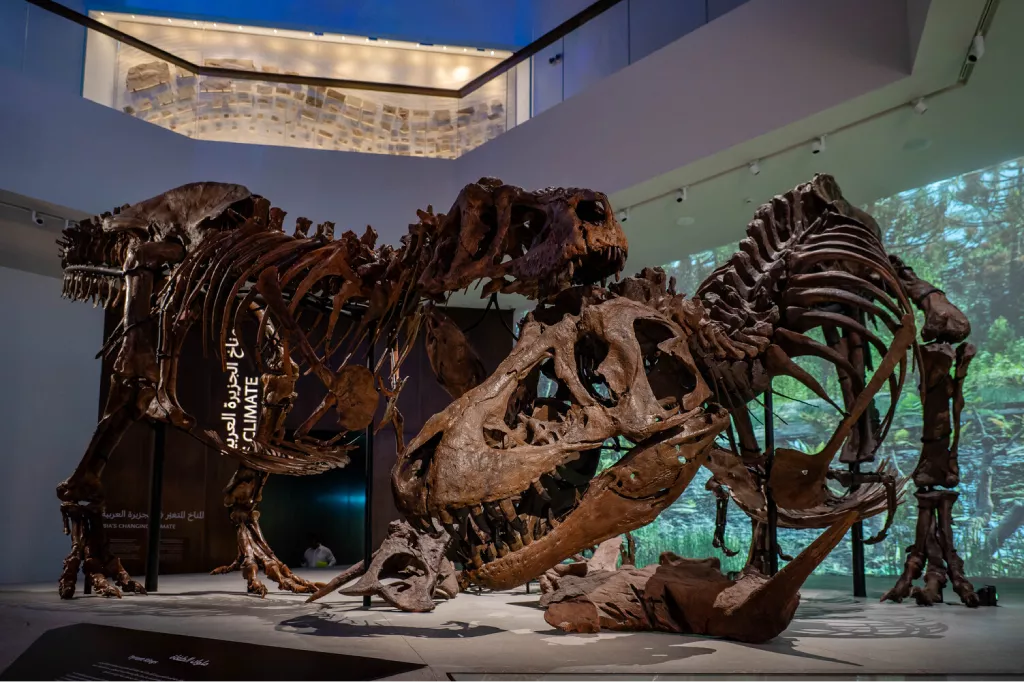
Tyrannosaurus rex skeletons | ArchDaily
The exhibition design team utilized highly directional lighting, moody shadows, and richly textured backdrops to turn this paleontological display into a gripping piece of three-dimensional theater.
Redefining Spatial Hierarchies
This emphasis on intimate, awe-inspiring scale continues in the aquatic wing, where the pristine skeleton of an 85-foot blue whale recovered from the shores of Nova Scotia in 2021 is suspended from the ceiling. But rather than hoisting the leviathan high into the inaccessible rafters, which has long been the typical approach of legacy institutions in New York or London, the designers made the inspired choice to lower the suspension.
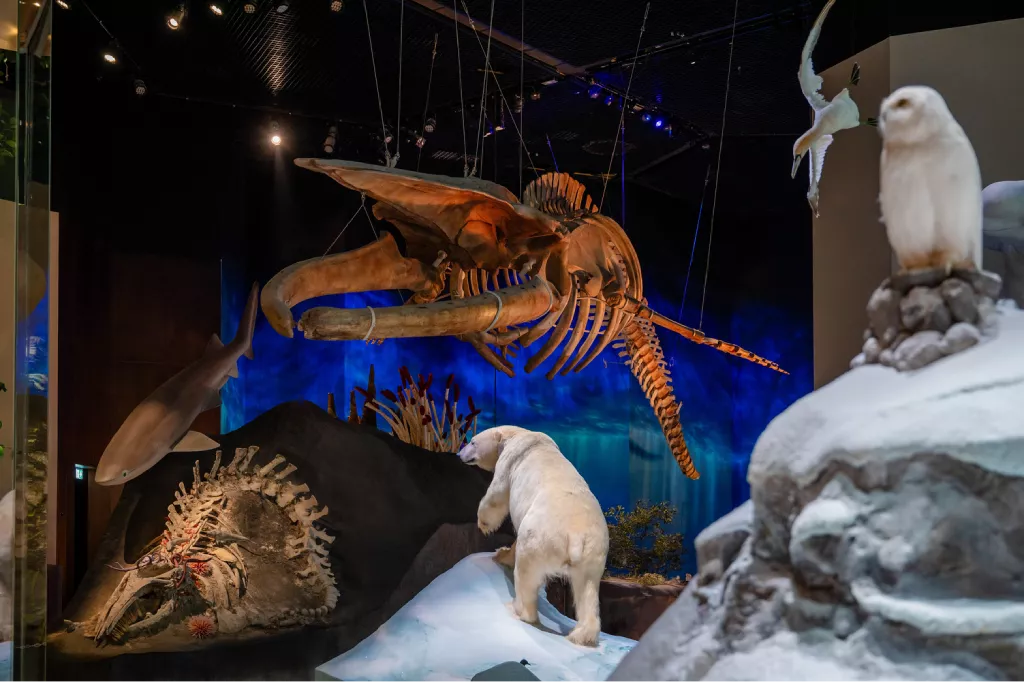
Suspended Blue Whale Skeleton | ArchDaily
The whale hovers a mere ten feet off the ground. The result is a profoundly grounding, almost intimidating physical experience; the sheer, unimaginable mass of the creature hovers just out of reach, dominating the room’s volume and forcing a hushed, reverent silence upon all who enter the space.
Anchoring the Infinite: Deep Time Through an Arabian Lens
Yet, for all its blockbuster megafauna and the cosmic wonder of exhibits like the Murchison Meteorite, a 7-billion-year-old specimen containing organic stardust older than our very solar system. True sophistication of the Natural History Museum Abu Dhabi lies in its regional grounding. The museum traces the 13.8-billion-year narrative of the universe, but it specifically pivots the lens to focus on the Arabian Peninsula.
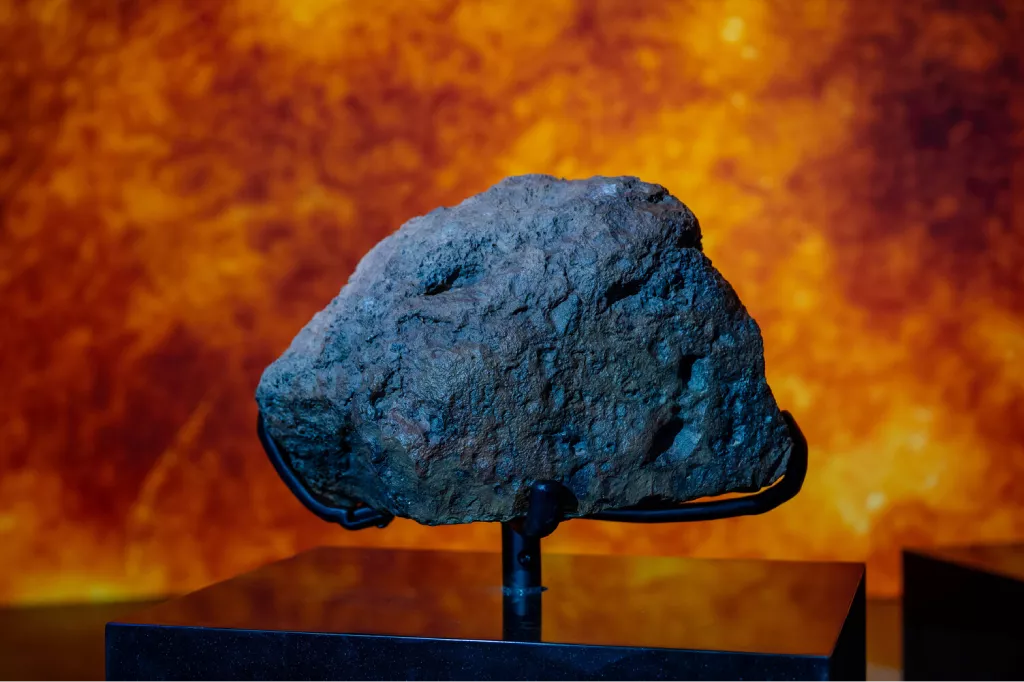
Ash Shaqqah 002 Meteorite | ArchDaily
Exhibitions transport visitors back seven million years to a time when Abu Dhabi was not a desert, but a verdant, river-fed savannah. This localized deep time is highlighted by the majestic Stegotetrabelodon emiratus, an extinct four-tusked giant elephant unearthed locally in the Baynunah Formation.
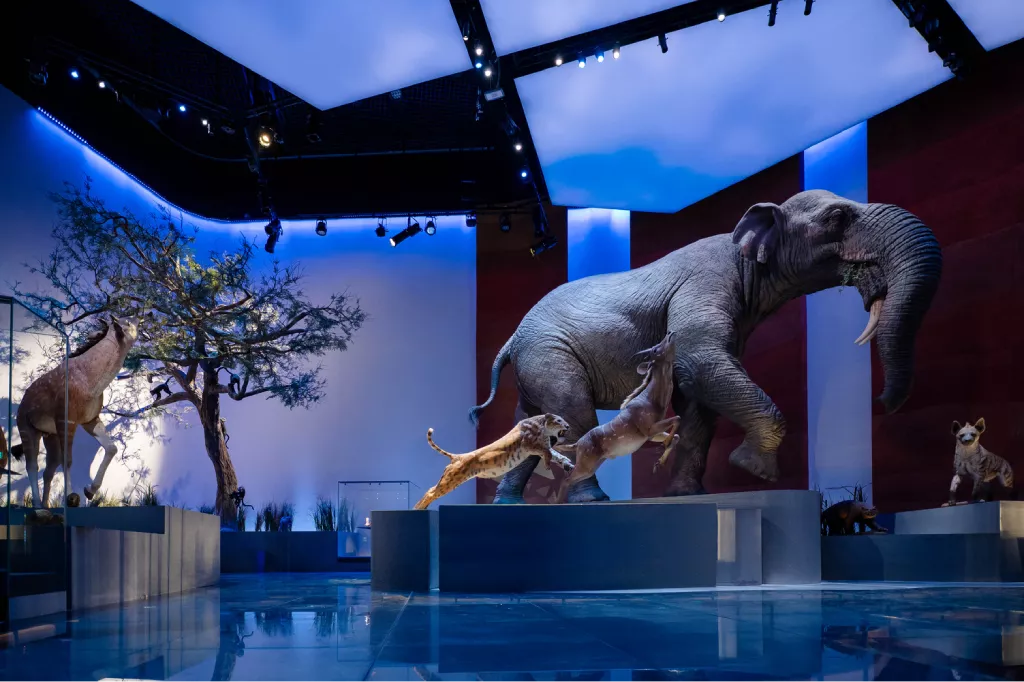
ArchDaily
Mecanoo has not simply designed a museum; it has weaved together the macroscopic scale of the universe, the microscopic perfection of cellular geometry, and the seamless integration of a waterfront urban master plan. The Natural History Museum Abu Dhabi stands as a triumph of contemporary design.
References
- https://www.mecanoo.nl/Projects/project/295/Natural-History-Museum-Abu-Dhabi
- https://dct.gov.ae/en/what.we.do/culture/museums/natural.history.museum.abu.dhabi..aspx
- https://www.nationalgeographic.com/culture/article/new-natural-history-museum-abu-dhabi-opening-dinosaurs
- https://www.mediaoffice.abudhabi/en/topic/natural-history-museum/
- https://www.turnerandtownsend.com/outcomes/natural-history-museum-abu-dhabi-uae/
- https://www.outlooktraveller.com/destinations/international/abu-dhabi-makes-global-waves-with-natural-history-museum-opening
- https://www.archdaily.com/1036303/mecanoos-natural-history-museum-opens-in-abu-dhabis-saadiyat-cultural-district