In the ephemeral, jet-setting world of collectible design, few events manage to weave location, legacy, and contemporary artistry into a single, cohesive narrative. Yet, the NOMAD fair, true to its name, has once again achieved this alchemy. For its landmark 2025 edition, NOMAD planted its flag not in a sterile convention center, but within the decommissioned halls of Terminal 1, Zayed International Airport in Abu Dhabi. From November 19 to 22, 2025, the fair transformed this architectural icon into a dazzling crucible for global design.
The very essence of NOMAD, the itinerant design fair, lies in its ability to combine the energy of mobility with the gravity of historical architecture, reviving the spirit of significant buildings across the world. In Abu Dhabi, this philosophy reached a new zenith. The fair’s timing was particularly auspicious, unfolding at a pivotal cultural moment that enriched the UAE’s already vibrant arts landscape. By coinciding with the broader citywide light-art exhibition ‘Manar‘, and aligning with the momentum of ‘Abu Dhabi Art‘, which is set to evolve into the prestigious frieze, NOMAD reinforced the emirate’s ambition to become the foremost cultural capital in the Middle East.
A Stage Set by Architectural History
The choice of venue was, in itself, a curatorial masterstroke, transforming a place of transit into a destination of culture. Conceived by the celebrated French architect Paul Andreu in the late 1970s and operational since the 1980s, Terminal 1 is a magnificent monument to regional modernism. Its distinctive, evocative design, a symphony of sweeping curves, vaulted ceilings, and purposeful brutalist elements, was perfectly aligned with NOMAD’s core philosophy: to revitalize the essence of significant buildings, allowing the architecture to transcend into displayed works. Andreu, the visionary behind Paris’s Charles de Gaulle Airport, injected a subtle elegance into the concrete shell, a sophisticated backdrop that challenged and inspired the participating designers.
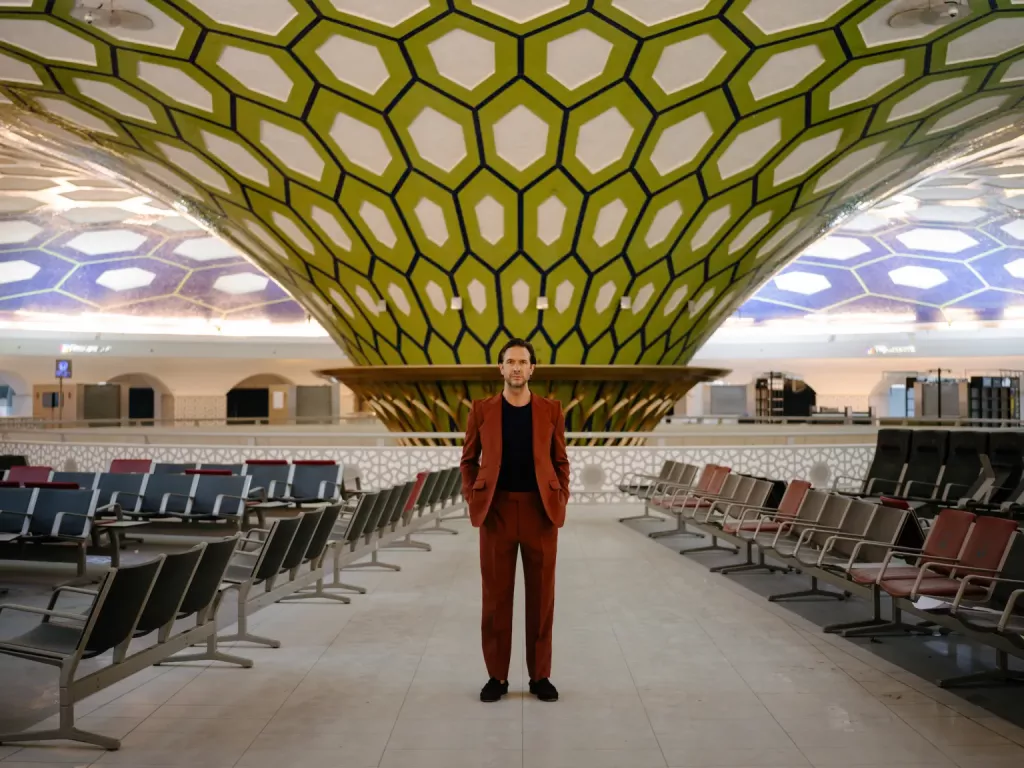
Nicolas Bellavance‑Lecompte (NOMAD’s founder) at Terminal 1 | CU
Closed to the public for years, the terminal’s vast, light-filled spaces were meticulously reimagined by NOMAD’s team in collaboration with the Department of Culture and Tourism of Abu Dhabi. As NOMAD founder Nicolas Bellavance-Lecompte emphasized, “We don’t build white cubes. The space itself must speak.” This sentiment transformed the terminal into a highly evocative spatial experience, linking the venue’s history directly to the cultural vision.
Standout Installations and Material Dialogues
Stepping through the terminal, attendees were immersed in a landscape where contemporary design paid profound homage to the structure’s mid-century aesthetic. The curated sections unfolded in dialogue with the architecture, leading eventually to the circular rotunda.
The initial installation, “Departures“, presented in partnership with Etihad Airways, set an ambitious, multi-sensory tone. Highlights included AA. Murakami’s contemplative work, Thousand Layers of Stomach, ingeniously transformed generative code derived from clam shells into an ethereal, flowing textile installation. This delicate piece was powerfully juxtaposed with Ali Chaaban’s witty, robust contribution: giant carpet sculptures shaped like airplanes, blending traditional craft with industrial form. Nearby, reflecting on memory and cultural identity, was A Nomadic Library by Mira Hawa Projects, Studio Etienne Bastormagi, and Dongola Limited Editions, a series of movable, foldable aluminum structures that perfectly embodied the fair’s transient spirit.
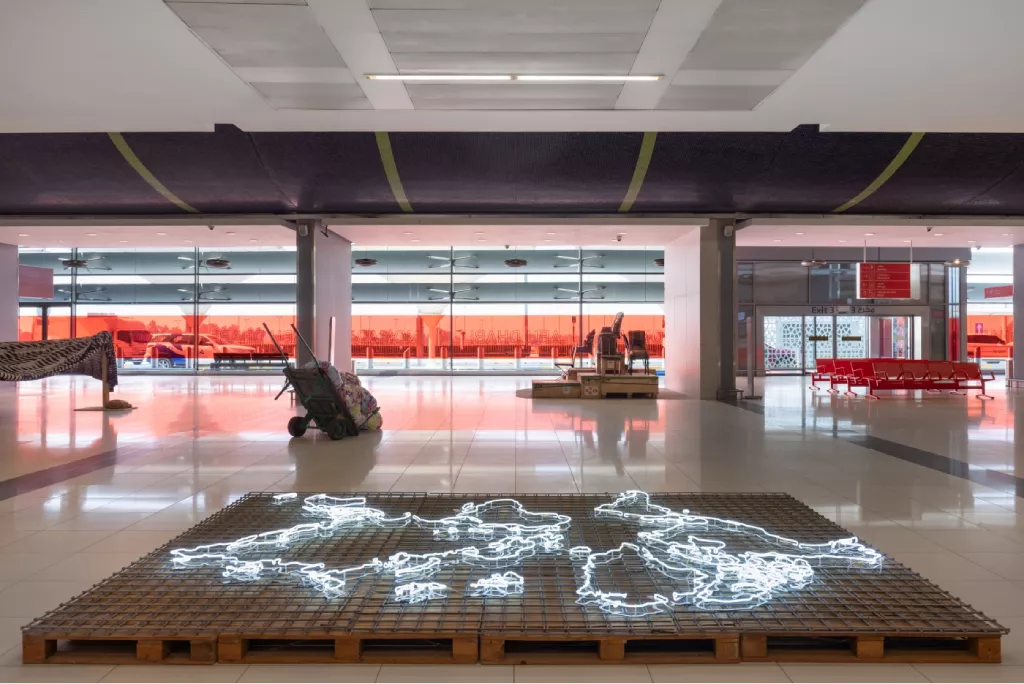
“Departures” at NOMAD Abu Dhabi | Boca Do Lobo
In the main exhibition areas, a constellation of international and regional galleries showcased a mastery of materiality. Galerie BSL presented striking stone tables by Nada Debs x Studio Lél, their geometric marquetry patterns directly mirroring Andreu’s iconic pentagonal ceiling structure. Gallery Fumi captivated with Kustaa Saksi’s visionary rugs, remarkable textile tapestries that served as a beautiful reinterpretation of regional weaving techniques.
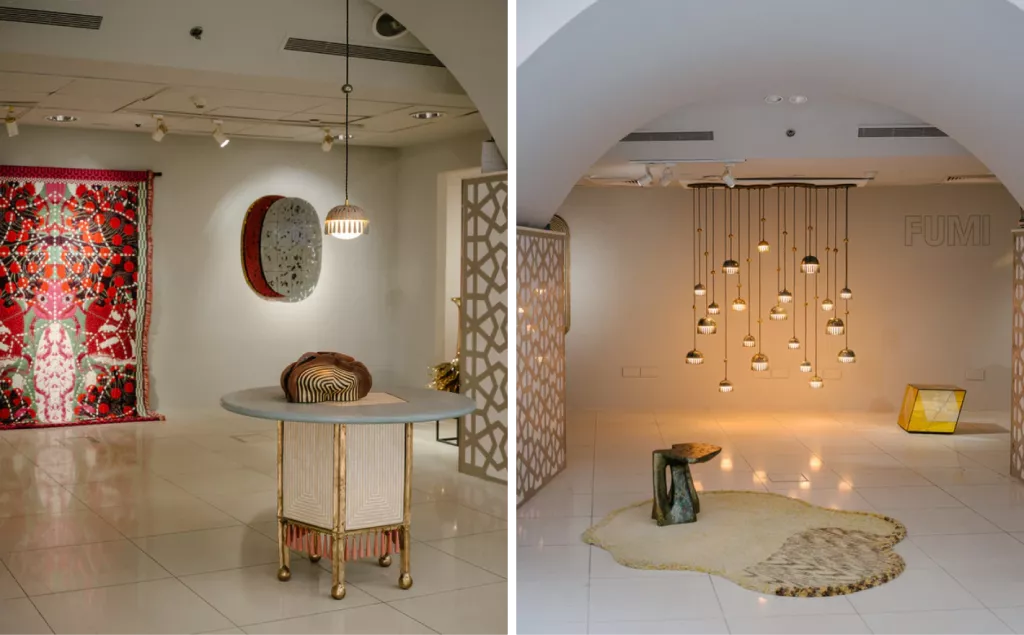
Installations at Gallery Fumi | Boca Do Lobo
The fair successfully fostered dialogue between global savoir-faire and local artisanship. The AP Room featured Aline Hazarian’s striking bronze-accented coffee table, a monolithic piece that commanded attention, while Bardo Collections introduced visitors to poetic Tunisian works, such as Aymen Mbarki’s refined terracotta side tables.
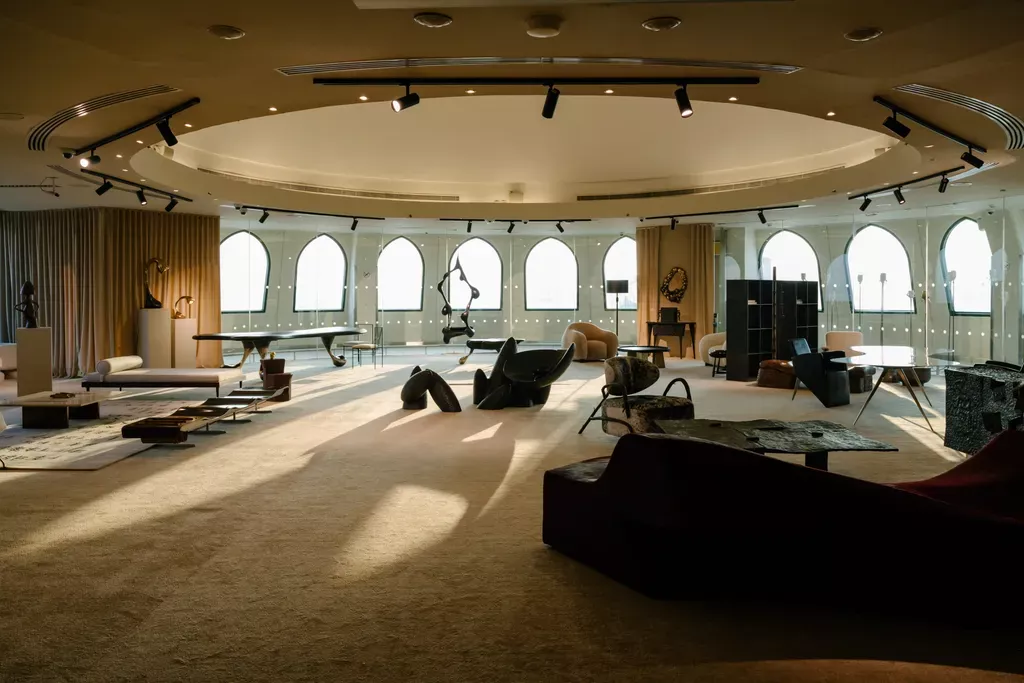
The AP Room | Wallpaper
Perhaps most resonant with the local culture was the display by Orient 499 in collaboration with David/Nicolas’s masterful wood and brass table and stool, Mida, executed as a homage to the local tradition of the majlis. Even the legendary glassworks of Dale Chihuly were celebrated by the Leila Heller Gallery beneath the rotunda’s decorated dome.
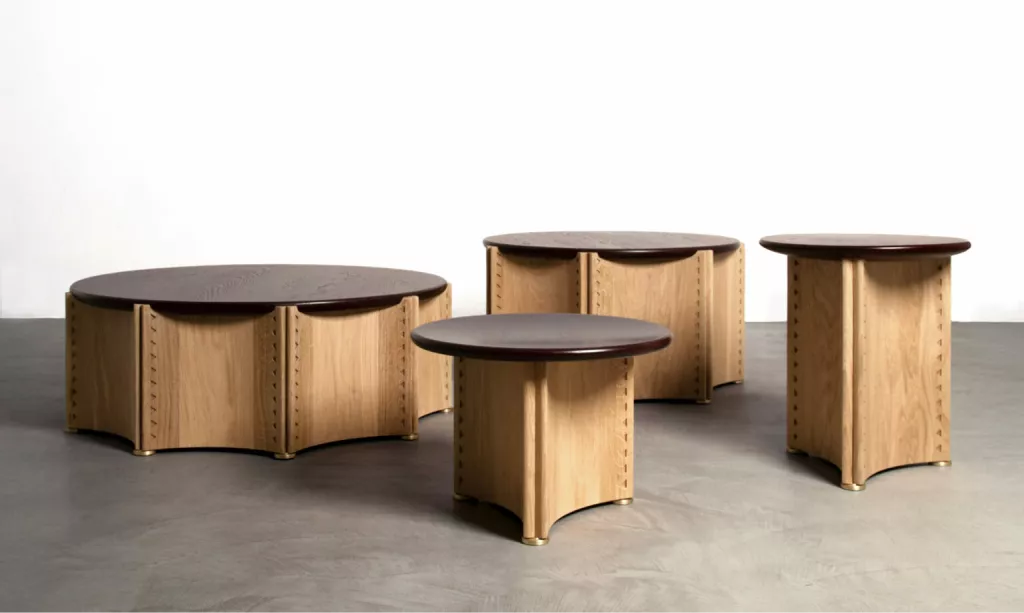
Mida | Marie Claire
Furthermore, We Gallery spotlighted Brazilian and Latin American masters such as Oscar Niemeyer, alongside young talents like Lucas Recchia with his highly collectible bullet side tables. The jewellery sector also gleamed, with the A2Z’s installation Dream Vault, alongside Studio Renn’s avant-garde pieces and Kamyen’s opulent high jewellery, housed within the industrial-chic modules of Modu.
Special Projects and Lasting Legacy
Among the most talked-about was Bottega Veneta’s installation, Destinations. Curated by Rana Beiruti, this project celebrated the 50th anniversary of the brand’s iconic Intrecciato leather weave by inviting artists to reinterpret the concept of weaving in a broader context. The centerpiece included a stunning green geometric structure by Abdalla Almulla, which drew direct inspiration from Emirati weaving traditions, and a poetic, luminous Totem by Nader Gammas, expertly crafted from hand-cut ceramic sheets. Elsewhere, Nilufar created a striking ‘slice’ layout in one of the waiting areas, skillfully softening the terminal’s industrial concrete with signature drapery and a selection of sculptural pieces in bronze, marble, and brass that seemed to float within the space.
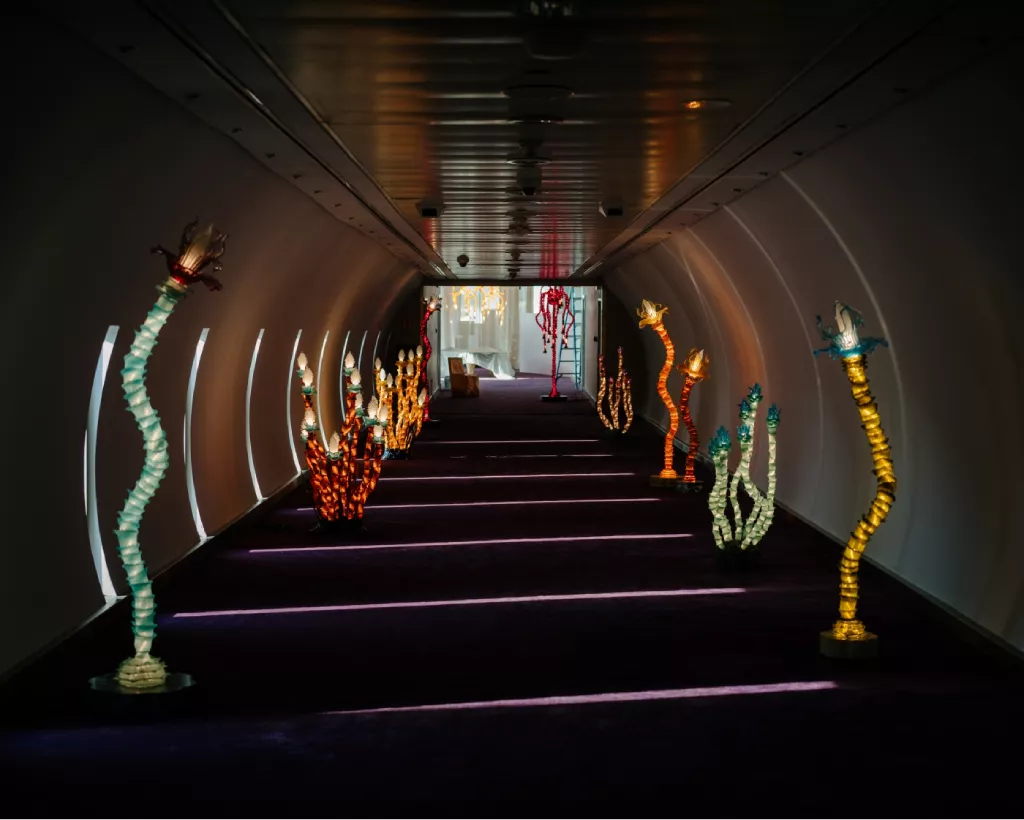
Nilufar: Sculptural Glass Spectacle | Boca Do Lobo
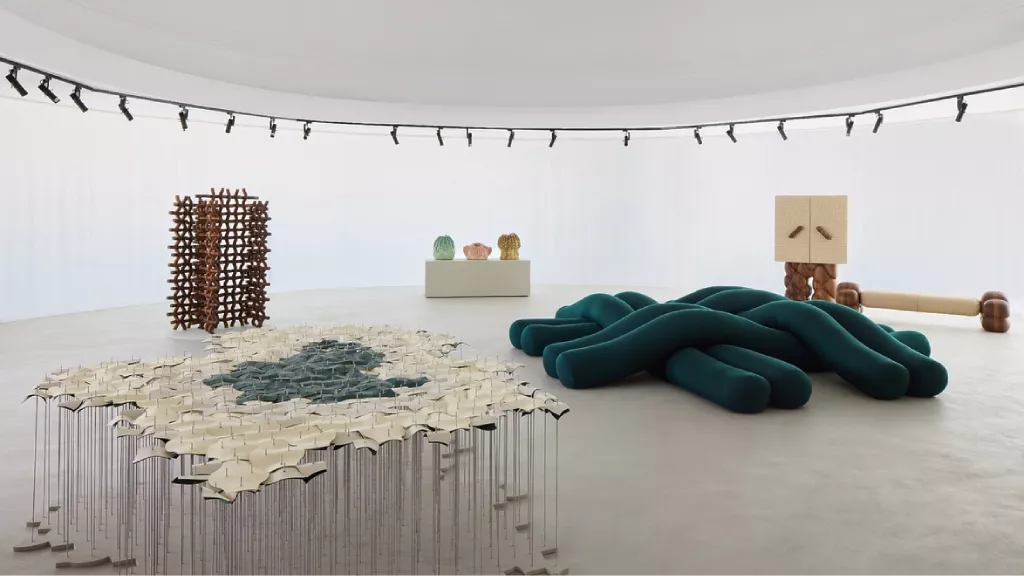
Installation by Bottega Veneta at “Destinations” | Boca Do Lobo
Beyond the main terminal, the fair’s cultural reach extended across Abu Dhabi. The off-site installation, Shifting Terrains, situated against the pristine backdrop of Jumeirah Saadiyat Island and presented by Inloco Gallery, was a poignant complement to the main fair. It featured Neda Salmanpour’s remarkable wind-carved vertical sand towers that appeared to have been naturally sculpted by the elements, reinforcing the dialogue between global design innovation and the local natural landscape. The fair also fostered talent through the House of Artisans Design Competition, ensuring the legacy of craft continues.
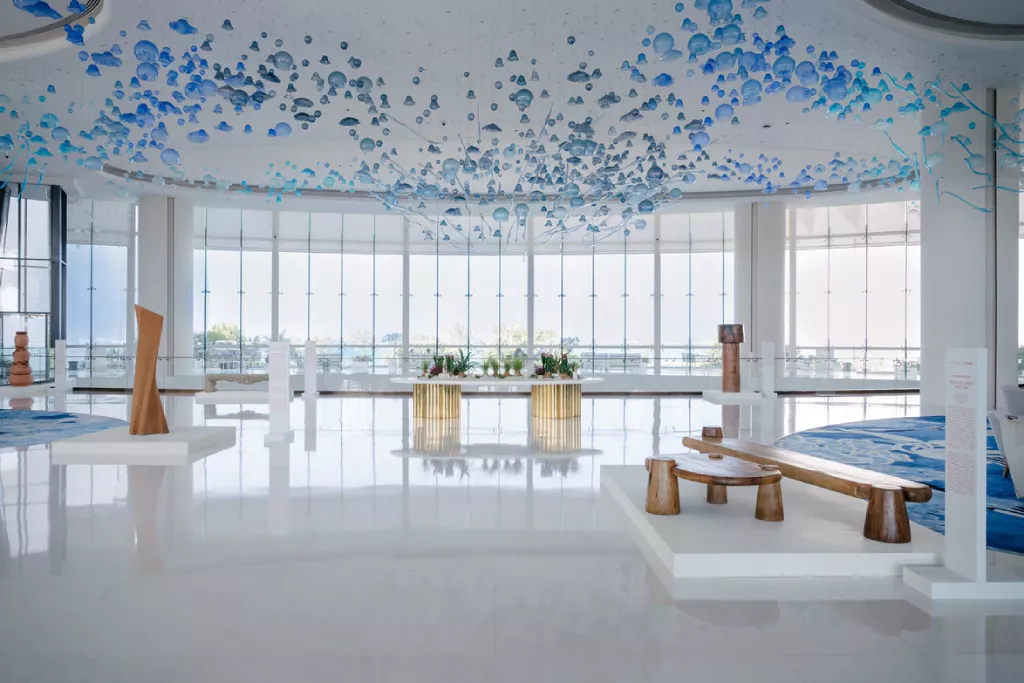
“Shifting Terrains” at Jumeirah Saadiyat Island Resort | Boca Do Lobo
By transforming a decommissioned airport terminal into a temporary epicenter of global creativity, NOMAD Abu Dhabi 2025 didn’t just showcase art and design; it provided a visionary blueprint for how cultural events can activate and reimagine the built environment. The robust sales reported on the opening days underscored this resounding success, cementing this edition as a triumphant and highly significant stop on the NOMAD circle.
References
- https://culturalunion.com/5-unmissable-design-and-cultural-highlights-at-nomad-abu-dhabi/
- https://www.nomad-circle.com/destinations/destination_nomad_abu_dhabi
- https://www.wallpaper.com/design-interiors/design-events/nomad-abu-dhabi-2025
- https://www.admiddleeast.com/story/what-to-see-at-nomad-abu-dhabi-the-standout-showcases-at-the-travelling-fair-for-art-and-design
- https://www.bocadolobo.com/en/inspiration-and-ideas/highlights-from-nomad-abu-dhabi-2025-a-landmark-edition-at-zayed-international-airport/
- https://www.admiddleeast.com/story/2025-nomad-abu-dhabi-travelling-art-design-fair-showcase-november
- https://designweekguide.com/event/nomad-art-design/